

We’ve now dived Mexico’s cave systems four times. Florida was always “next.” The high-flow reputation was enough to keep kicking that can down the road. However, in June 2026, Kevin and I finally booked the flights and hired a guide.
Full Cave certified since October 2025. First time in Florida’s springs. Five days, three dive sites, one ER visit.
>>Read more: the full progression from recreational diver to cave diver that led to this trip on “The Technical Ascent: My Unfiltered Journey into Cave Diving and Trimix (and Why I Almost Quit)“
At a glance
Practical Stuff
Let’s just get the practical stuff out of way to help your next planning quickly 😍Since this is our first time in the Cave Country, we opted to hire a guide, Joey McNamara, to show us around. Joey is super friendly, looooovvveeee diving and is friend with everyone. I love the diving stories he told us!
>> Read more: Our guide – Joey’s website “McNamara Marine“
Certifications
I personally think Full Cave with the knowledge and ability to use deco tank (such as ANDP or ART+) is necessary in Cave Country. Depth and flow together = high gas consumption. The ⅙ rule on back gas barely gets you past the entrance at Devil’s Ear. Because of the depth, decompression is almost gurantee in practice. So one needs to know how to run a deco bottle.
We didn’t have stage and didn’t use stage. But the cave system is long and depth so I can see it is useful for higher-SAC rate divers or anyting wanting a longer penetration.
For open water divers, the options seem limited. Ginne Springs however do have a designated OW-friendly and training areas. We also see free divers in Peacock Springs.
Best Time to Visit
| Season | Notes |
|---|---|
| Winter/Spring | Classic. Cooler topside, less crowded, more comfortable for drysuit divers. |
| May to mid-June | Good window before school lets out. Crowds manageable. |
| Late June onward | School’s out. Recreation crowds increase significantly, especially weekends. |
| Summer | Topside heat is significant. Regular thurnderstorm can be unpredictable for water flow. |
| Fall | Hurricane season can be unpredictable due to rain fall. |
Tank Rental & Gas Fills
Joey works with Extreme Exposure (EE), so that’s what we used. The fill setup is clever: hoses extend directly into your car or truck, so your doubles stay in the vehicle the whole time. No hauling tanks up and down. Fills take about 30 minutes when there is no line and can handle at least four sets simultaneously.
| Shop | Extreme Exposure, High Springs |
| Doubles fill (32% nitrox) | $50 for two sets per day |
| Deco tank (100% O2, AL40) | $15 per day |
| DPV rental | $75 per day |
After each dive day, we drove back to EE, handed over the tanks, and spent the fill time reviewing cave maps and planning the next dive. The logistics flow is smooth enough that it becomes part of the dive day rhythm.
>> Read more: check out the current rental prices on Extreme Exposure
No tank hauling required. Extreme Exposure fills doubles right in the truck bed.
Accommodation
Vacation rental in High Springs (Lilly in the Spring Suites), booked via Booking.com, about $800 for the week. Walking distance to Extreme Exposure, well-stocked kitchen, comfortable setup.
Two hotels and motels in the area, High Springs Country Inn and BlueGem Motel, are also options if you prefer hotels.
Gear Adjustments from Mexico and the PNW
Florida springs run around 70°F, slightly cooler than Tulum (77°F) but much warmer than Puget Sound (49-54°F). I wore the same 250gsm undergarments I use in Mexico, with a t-shirt and shorts underneath, but swapped to a 3mm hood instead of my Fourth Element Thermocline (2mm equivalent).
I used 2mm neoprene gloves that I’d cut into fingerless. That worked, but I’d keep other fingers intact except thumb and index finger next time to protect against rock scraping during pull and glide. Joey also recommended replacing shoelaces on rock boots with alternative closures to reduce entanglement hazard. Worth doing before you arrive.
>>Read more: the full Mexico cave system comparison that provides context for how Florida differs on “The Ultimate Guide to Diving Tulum: Cenotes, Caverns, & Caves“
>>Read more: how to pack for a backmount doubles cave trip, including drysuit logistics and gear checklists on “A Framework for Packing a Cave Trip: Backmount Doubles Edition“
>>Up Next: A full undergarment layering guide across water temperatures, from Puget Sound to Tulum to Florida springs.
Dive Sites
| Site | Fee | Notes | Facilities |
|---|---|---|---|
| Ginnie Springs | $28 per cave diver | Different prices for different activities | Restroom building (under construction during our visit), benches, gearing area |
| Peacock Springs | $4 per vehicle | Cash only, envelope system, no attendant | Spacious changing rooms, porta potties |
| Little River Springs | $5 per vehicle | Card only | Porta potties, walkway, partial staircase access |
| Cow Spring | $35 per person annually | NSS-CDS membership required | — |
Day 1 — Ginnie Springs
Ginnie Springs is about 10 minutes from High Springs and serves double duty as a local recreation spot and a training ground for recreational, cave, tech, and rebreather divers. The lines are clear, the passages are large, and delicate formations are minimal. Standard first stop for new-to-Florida cave divers.
We arrived Monday morning to a quiet spring. By the time we were gearing up for our second dive, recreational floaters had taken over the surface in force. Negotiating a crowd of giant inflatable unicorns on your way to the cave entrance is apparently a Florida cave diving rite of passage.
Same spot, 3 hours apart. Florida cave diving's biggest obstacle: floaties.
We dove Devil’s Eye and Devil’s Ear. Both have the classic Florida outflow: water moving out of the cave, which means pulling and gliding against the current on the way in and drifting out effortlessly on the way back. Devil’s Ear in particular — the entry is nearly vertical, and the flow is pushing you out as you’re trying to descend in. Getting negative enough to climb in took real effort. Joey made it look effortless. I almost get blown away.

This was my first time experiencing high-flow cave diving. I was slow, inefficient, and tired by the end. Going in, I was so focused on managing the flow and learning pull and glide that I processed maybe half of what I was actually looking at. Talking about task-loading…Coming out, I just stayed neutrally buoyant and let the flow do the work. Much more relaxing!
Lesson: don’t kick when pull and guide. Tuck behind the rocks to save the energies if needed.
The formations at Ginnie are interesting in a different way from Mexico: less “decorative cave,” more like traversing an underwater dry cave. Large passages, high ceilings, a lot of horizontal space. No halocline, and visibility is excellent.
One unexpected highlight: I liked the LP85 steel doubles a lot more than I expected. I’d used them once during intro to cave training and found them too heavy. Three years of HP100 doubles at home and some gym time later, they’re easy to manage. As a shorter diver, the LP85’s smaller footprint gives my legs noticeably more room. Worth considering if you’re petite and used to AL80s.
>> Read more: official website of Ginne Springs
>>Up Next: AL80 vs. LP85 vs. HP100 comparison for petite divers — which one is easier to manage?
Day 2 — Wes Skiles Peacock Springs
Peacock Springs State Park is about an hour from High Springs. The park has several separate entry points: Orange Grove (where we saw free divers), Peacock I, and Peacock III, each with its own parking and setup area. The changing rooms are spacious. Restrooms are porta potties.


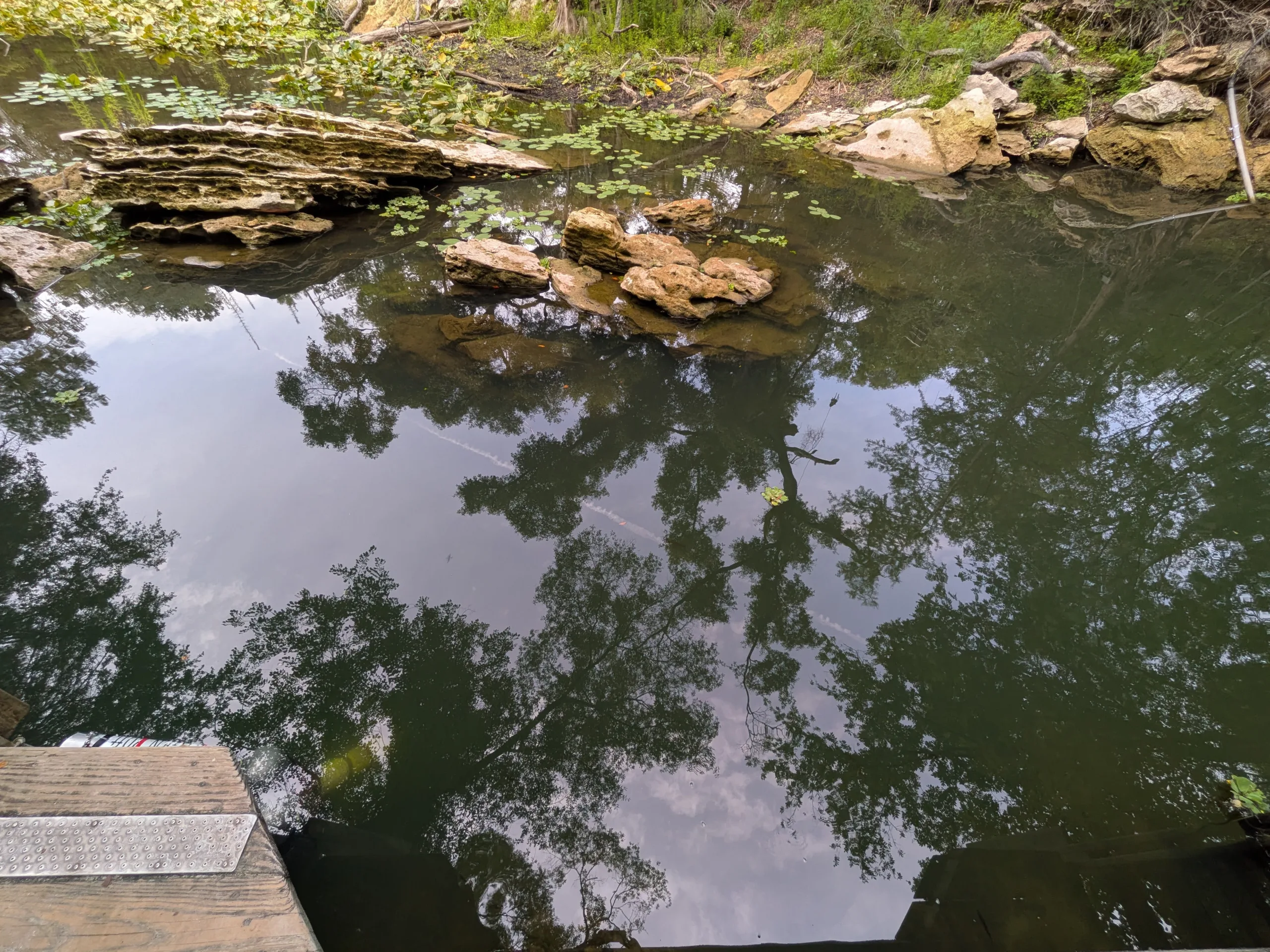
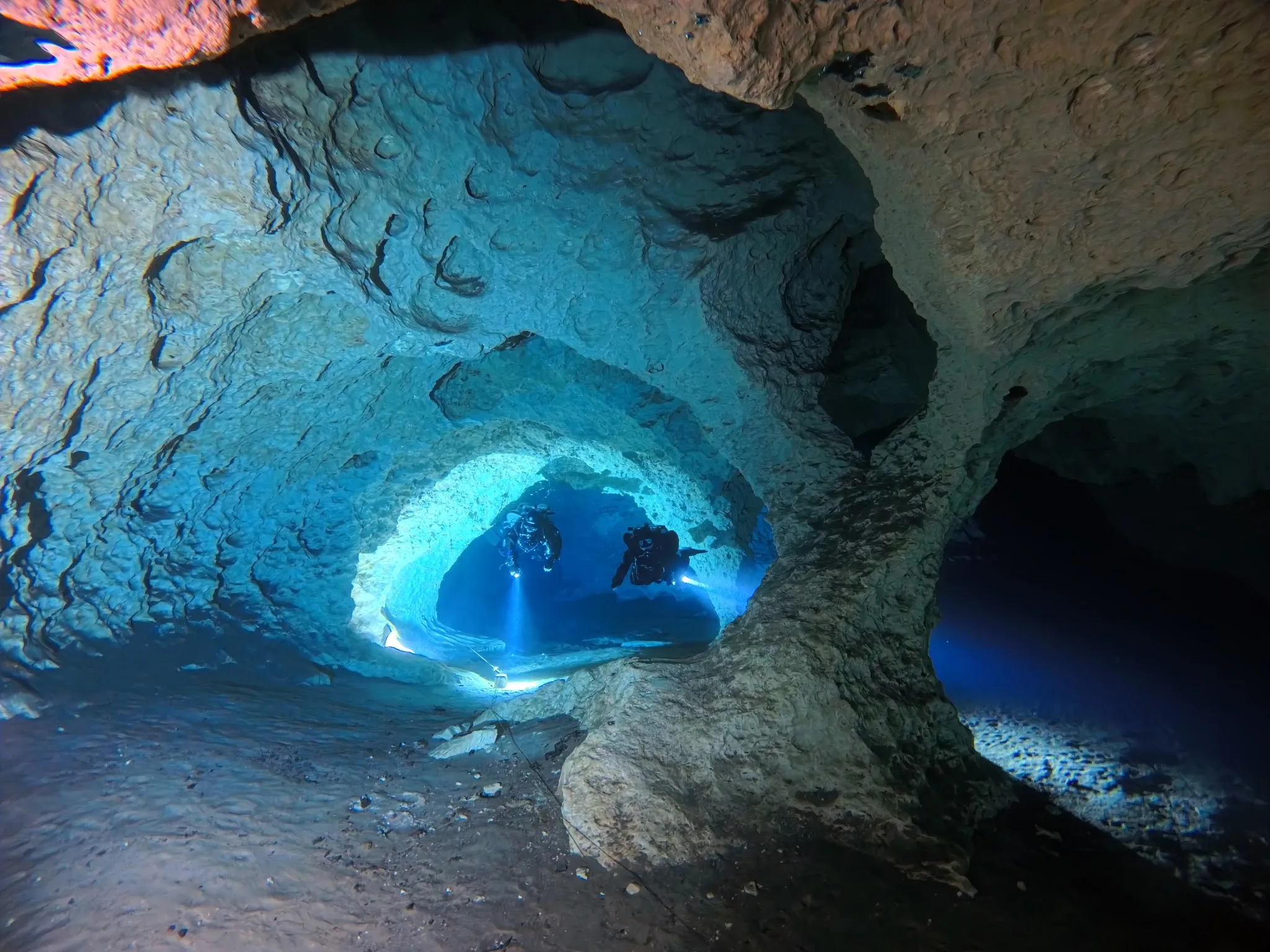
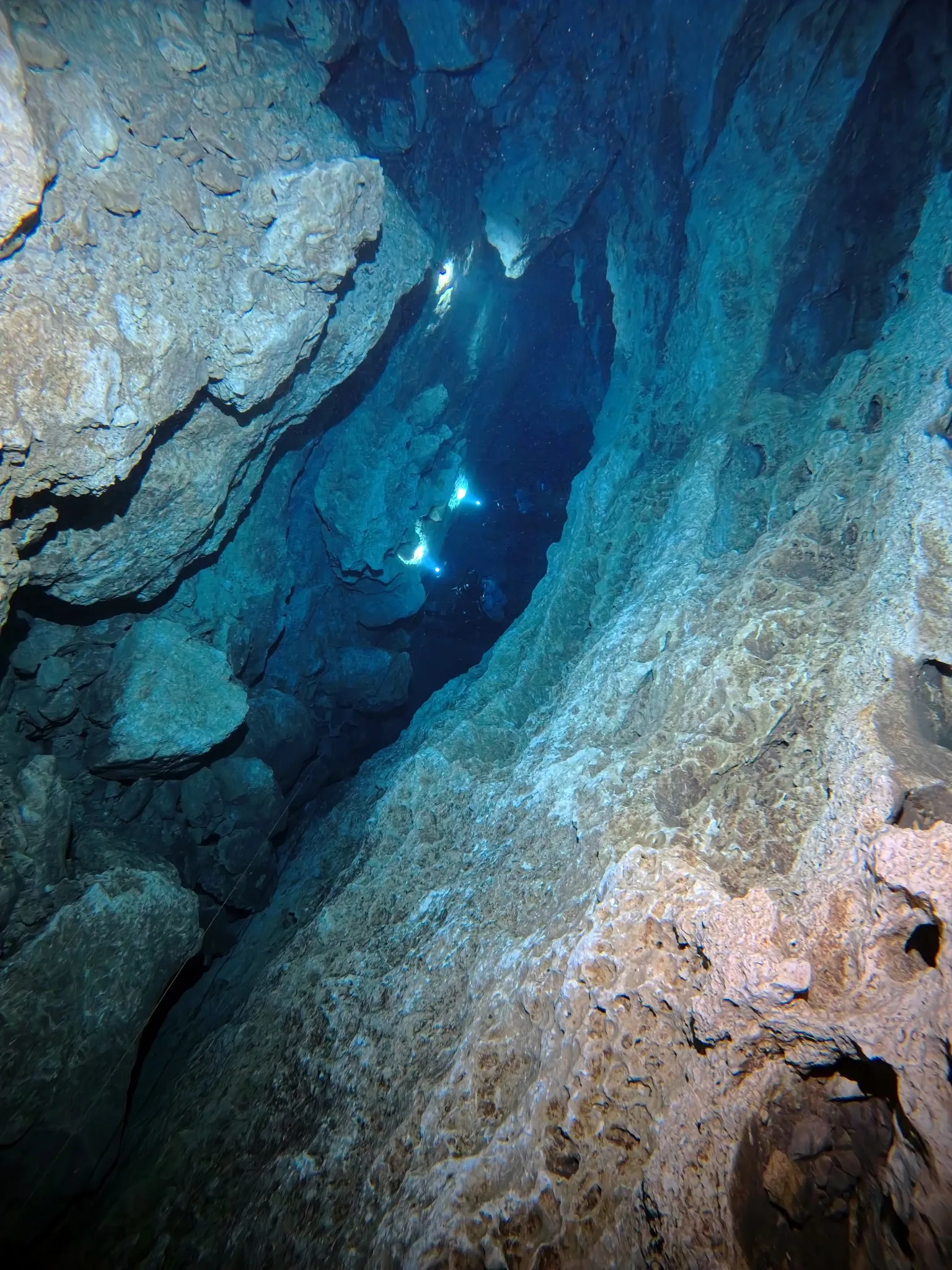
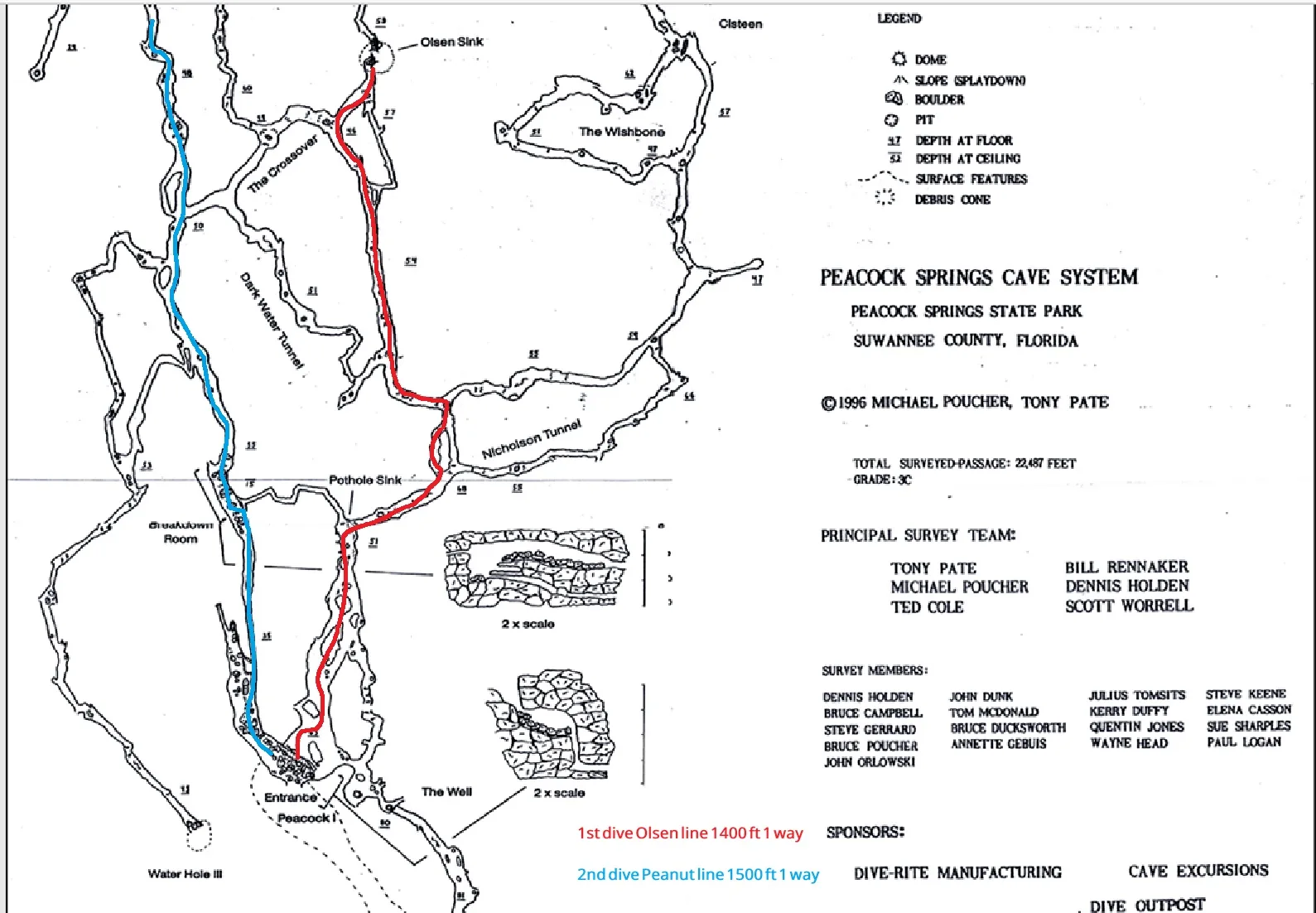
Peacock I‘s entry is a small pond. You can giant stride (watch for divers below) or walk backwards down the vertical stairs. I chose the stairs. Entry into the cave system is through a crack opening, not immediately obvious, but the gold line starts just inside the cavern.
The notable difference from Ginnie: no flow. The moment I dropped in, I felt at home. No fighting the current, just clean cave diving through a system carved by ancient river flow rather than filled with stalactites. That geological difference means the formations are smoother and more forgiving of contact.
We saw cave crawfish (adults and one tiny juvenile), catfish drifting in the dark, and some wet rocks with fossils.
Dive 1: Olsen line to Olsen sink, surfacing with a reel at the sink. I miscalculated my gas turn pressure and turned around with about 10 bar still usable. Lesson: say the turn pressure out loud before going in. The historic drought was visible at Olsen sink. What used to be a walk-out is now a proper sinkhole with vegetation overgrowing the rim.
Lesson: say the turn pressure out loud before going in.
Dive 2: Peanut line, and my first experience with staged underwater photography. Joey signaled us to hold position, swam around to set up video lights, and photographed us from afar. I tried to approximate the body position I’ve seen in other cave shots. The results came out looking professional.
>> Read more: official website of Wes Skiles Peacock Springs State Park
Day 3 — Little River Springs
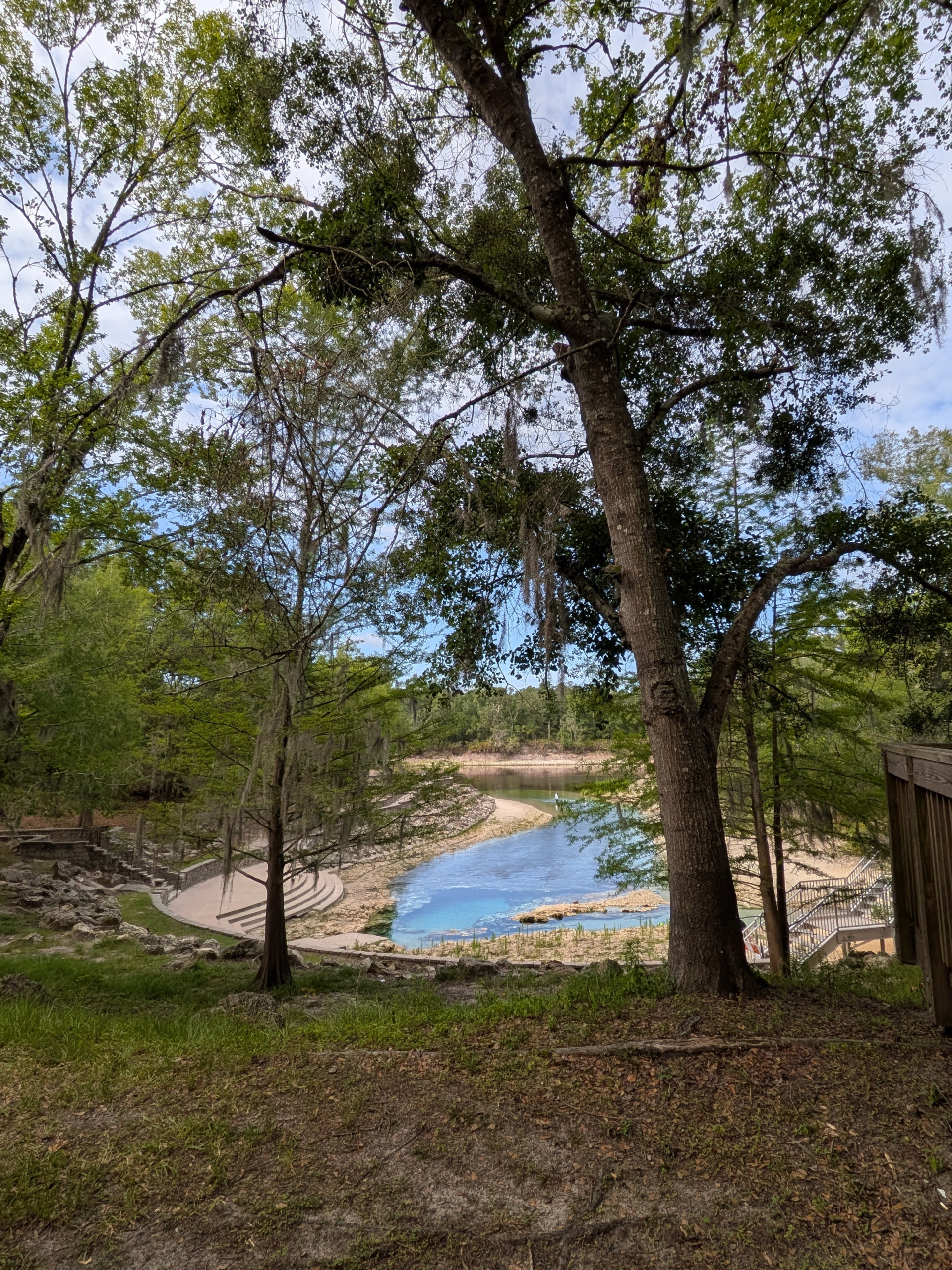
Little River Springs is about an hour from High Springs and is also a popular local swimming spot. The walkway around the spring is well-maintained. Part of the direct staircase access was under construction during our visit. Joey said that staircase has been unreliable for a while. We used the sandy area nearby to wade in instead.
Joey prepped us: the flow here is typically stronger than Ginnie Springs. The historic drought had cut it significantly this trip though, low enough that Joey could actually back fin against the current, something he said he’s never done at this site. For me, it was still a meaningful challenge.


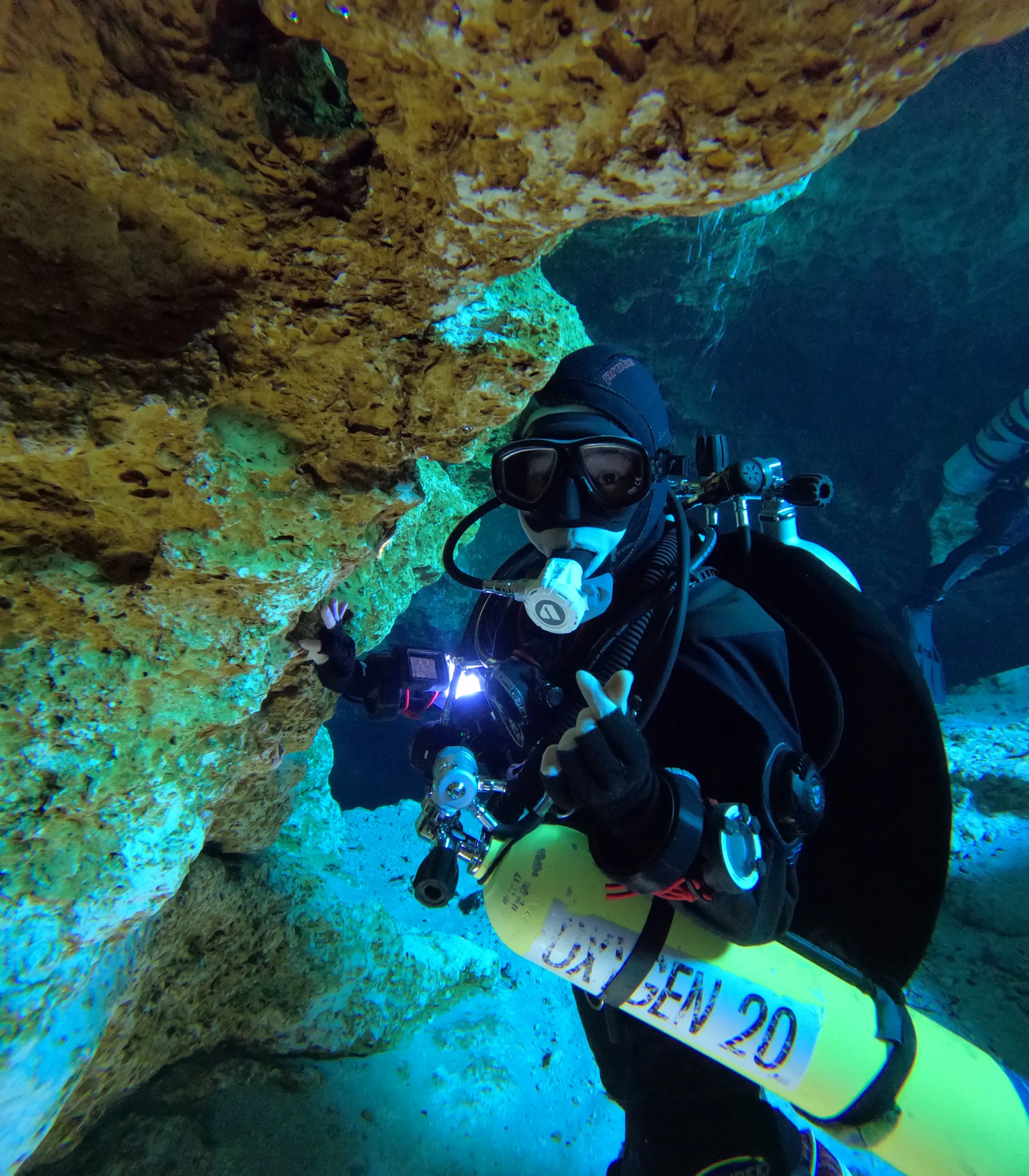
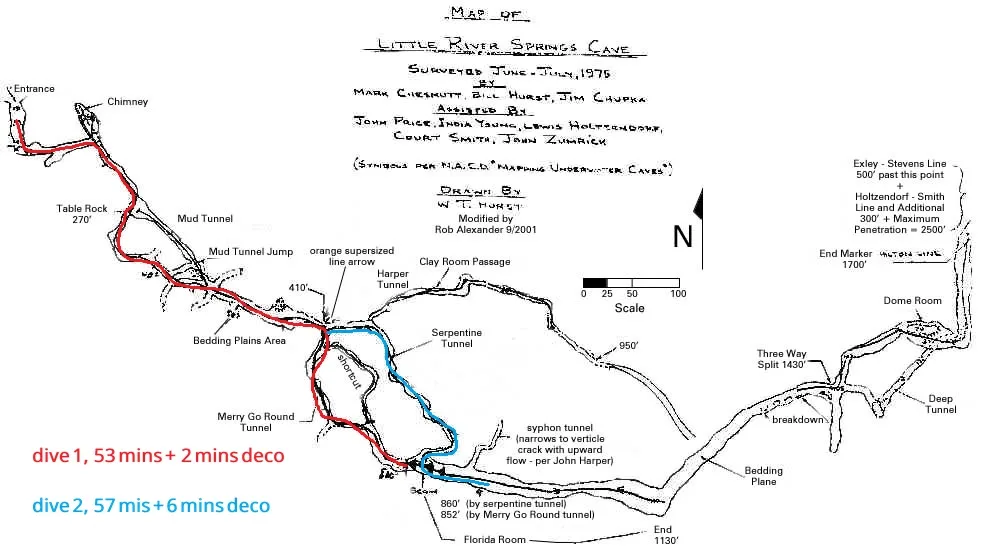
We dove the Merry Go Round and Serpentine lines. The first section before the giant T junction was my favorite passage from the whole trip: manageable flow with structure just about to fit one person comfortably with some twist and turns and river carving rocks. The Serpentine line is exactly what it sounds like, a series of tight turns snaking through the passage. By Day 3, my pull and glide was noticeably more efficient. Not elegant, but better.
Deco was spent tucked into a corner near the entrance, staying negative to hold position against the outward flow. A small flatfish sat motionless on the rock about a foot from my mask for most of the stop. Cave diving deco is peaceful when you find the right corner.
>>Watch the dive: Serpentine Line at Little River Springs. if the preview doesn’t work, watch here https://www.youtube.com/watch?v=c-jSHeuziSI
Joey mentioned something that stuck: a lot of the boardwalks, benches, and staircases at Florida cave sites were built and funded by the diving community. You can tell when you’re gearing up. The bench heights, the layout, the proximity to the water — it’s set up by people who actually dive.
>> Read more: official website of Little River Springs
Day 4 — The ER
Lesson: when one feels great, their body might not agree
Well.. if you know my parents, don’t read the rest of the article, or at least don’t tell them.
>> Read more: “Diagnosing Decompression Sickness (DCS) diagnosis” on Divers Alert Network (DAN)
After dive day 3, right before bed, my right upper arm was noticeably swollen, hot, and red. No pain, no other symptoms. I went to sleep and made a note to check with DAN in the morning.
By morning it was better, but still swollen and warm. No pain, no symptoms matching my previous mild DCS experience: no eye jumping, no underarm rash. Still, something was off so I called DAN for consultation.
The DAN medic walked me through it and recommended the ER to rule out lymphatic DCS, which can sometimes present with localized swelling and heat without the more obvious neurological symptoms. I didn’t have a strong sense this was DCS — but I didn’t have a strong sense it wasn’t. So I went.
Kevin went diving at Cow Springs as planned, which required NSS-CDS memebership (bought online for $35). It sounds fantastically narrow though.
I spent Friday afternoon at UF Health Shands Hospital. They ran a chest X-ray, vascular ultrasound, and blood panels. X-ray normal. Blood work showed elevated Creatine Kinase (CK) levels, a marker for muscle breakdown. The ER team’s assessment: DCS unlikely. Final diagnosis: acute localized muscle breakdown in my right arm from three consecutive days of pull and glide against cave flow.

Six hours, one IV, and thankfully not DCS.IV fluids to flush the CK levels down, then sent home. No follow-up needed.
The explanation makes sense. Pull and glide can be an asymmetric motion when one is still learning it, and I’m right-hand dominant. I am not sure how but apparently two days of repeated pulling against strong current was enough to cause measurable muscle damage, even though I work out regularly (my 1-rep max bench press and overhead press are about 0.6x of my body weight). Cave diving is definitely physical.
🚨CALL DAN WHEN IN DOUBT🚑
If something is off after a dive, even if you feel mostly fine, even if it doesn’t match textbook DCS , call DAN first.
The hotline is staffed by dive medical professionals and they’ll walk you through exactly what to do. The cost of the call is zero.
DAN 24/7 Emergency Hotline: +1-919-684-9111
DAN Memebr services: +1-919-684-2948 (Available 8:30am – 5pm ET)
DAN dive insurance also covers the claim process. I’ll submit my ER visit costs after my health insurance processes their portion.
Day 5 — Tax Day
Arm still recovering. I went to EE with Kevin in the morning, listened to Joey brief the DPV tryout plan at Ginnie Springs, and then watched them drive off to the site.
Then I did quarterly estimated taxes while resting.
Final Thoughts
I’m grateful that even though the trip was cut short and included an ER day, a clear blood marker made the diagnosis straightforward. Now I know my body’s signals when it’s dealing with muscle breakdown versus DCS. I know what calling DAN feels like in practice. And I know that surface oxygen is always the right first move, regardless of what you think is causing the problem.
I’m also glad that by Day 3, I was handling the flow better and enjoying myself. That part went right.
What I’d Do Differently
Gear:
- keep other fingers intact except thumb and index finger next time to protect against rock scraping during pull and glide.
- Cover up the shoelaces on rock boots before you arrive.
Logistics:
- A free minivan upgrade on our rental car was unplanned luck, but useful for transporting 4 sets of doubles + 2 deco tanks and all other gears every day. Worth considering when booking.
- EE’s fill logistics are so smooth that there’s no stress about tanks and fills. Plan your dives, let them handle the rest.
Pacing:
- Three consecutive high-flow dive days was too many for my current pull and glide proficiency. I’d also build in more surface interval between back-to-back deco dives.
- Site order worked well: Ginnie (high flow, high traffic, good training ground) → Peacock (no flow, confidence builder) → Little River (flow, but more efficient by then). I’d keep that sequence.
Skills:
- The flow is difficult but manageable. Recent experience with currents in PNW diving helped more than I expected. Being comfortable in moving water in a drysuit translates.
Frequently Asked Questions
Do I need Full Cave certification to dive Ginnie Springs?
For the main cave system (Devil’s Eye and Devil’s Ear), Full Cave is strongly recommended. The depth and flow mean an Intro to Cave diver’s ⅙ gas rule is exhausted near the entrance. There are OW-accessible areas at Ginnie if you’re not yet cave certified.
What is pull and glide, and why is it hard?
Pull and glide is the primary propulsion technique in flow-heavy cave systems. Instead of kicking, you grip the rock walls or ceiling and pull yourself forward against the current, then glide when momentum carries you. It’s physically demanding, especially asymmetric if you’re dominant on one side. Budget significantly more energy than you expect on your first Florida trip.
How do I arrange gas fills for cave diving in Florida?
Local dive shops handle fills and often coordinate with guides. We used Extreme Exposure in High Springs. Their vehicle-side fill hoses are particularly smooth. Cave Country Dive Shop by by Paragon Dive Group is the other main shop in the area. If you’re hiring a guide, ask which shop they use and coordinate fills and rentals through them.
What should I do if I have unusual symptoms after a cave dive?
Use surface oxygen if available — it’s never the wrong call. Then call DAN. The DAN medical hotline is staffed by dive medical professionals who will walk you through an assessment and advise on next steps. Don’t wait to see if symptoms resolve. Don’t assume it’s not DCS just because it doesn’t match the textbook description. Call DAN first.
Is Florida cave diving suitable right after Full Cave certification?
Yes. Florida’s springs are where a lot of divers do their full cave training in the first place. Ginnie Springs is a standard training environment. Hiring a guide for your first independent trip is a reasonable call for site familiarity and gas planning support.

About Pan — Full Cave and Advanced Recreational Trimix diver based in the Pacific Northwest. I started diving without knowing how to swim; now I drive three hours each way to dive in Puget Sound/Hood Canal. Two Ocean Notes documents the technical progression, gear decisions, and travel planning behind this dive life — from a petite engineer’s perspective, without the fluff. → Read my full story
FOLLOW ME
For My Latest Dive Stories & Journey
Editorial disclaimer
Please be aware that scuba diving is an inherently risky activity, even with certification and experience. The content on this blog reflects my personal opinions and experiences and should not be considered instructional. Always prioritize safety, seek guidance and certification from qualified diving professionals, and carefully consider the risks involved in any dives.
Discover more from Two Ocean Notes
Subscribe to get the latest posts sent to your email.

