
At a glance
We were lucky to join UB Diving’s first season running Nanaimo wrecks that we found out by scrolling Facebook. A month later, we were riding the boat elevator, all smiles, fresh off a 440-foot Canadian warship. Worth the 5.5 hour drive + 2 hour ferry trek from Portland.
>> Read more: official website of UB Diving
>> Read more: what PNW cold water diving demands before you book a wreck charter on “Cold, Miserable, but Lively: Cold Water Diving in the Pacific Northwest“
Visual: The Vessel
If the video above doesn’t work, see https://youtube.com/shorts/ZGFqr_luLXI
Logistics
Booking
We heard about UB Diving at God’s Pocket — two guests on that trip had dove with them right before and had good feedback, and we saw them at the dock too. We didn’t realize they’d also run trips to Nanaimo wrecks then. I was scrolling Facebook, saw the ad, checked the website, and found two days open over Juneteenth weekend. Sold on the spot.
>>Read more: the resort trip that put UB Diving on our radar in the first place on “Diving God’s Pocket: 15 Dives and One Unexpected Night in Port Hardy“
The booking page is light on details, so I called to book over the phone. AL80 tanks and air are included; we requested HP100 tank (subject to availability) and Nitrox (+$20 CAD per tank).
Since this was UB Diving’s first year running the Nanaimo trip, a few things needed ironing out. We didn’t get meeting details until we called and emailed the day before — apparently a system glitch meant every guest was calling that day. Sean and Shellie were keen on feedback and already fixed the bug when I spoke with them, so I’d expect this to be smoothed out already.
>>Read more: what else is worth stopping for on the way up to Vancouver Island on “Vancouver Island in 8 Nights: Dive Scouting and a Party Cave in the 60s“
Morning logistics
We met at 9:30am at Brechin Boat Launch. Like any day boat trip, we arrived about 45 minutes early to set up gear and get a head start on suiting up. The launch has three boat ramps plus kayak ramps and gets busy on weekends. Parking is CAD $6/day by credit card — we paid and still got a $0 warning ticket for “no visible means of launching,” so next time I’ll clarify with UB Diving about where to park.
Sean drove the boat onto the ramp himself; easy to spot. We loaded gear, went back to the car to suit up in drysuits, and boarded. Some divers suited up during the ride out instead.

On Board
Safety briefing was clear: emergency O2, fire extinguisher, first aid kit, radio, and flotation devices. The wreck sites sit close to the ferry route, so passing ferries kick up a bigger wake. Sean will shout out when that happens so remember to hold onto something.
The boat is built for diving first. The outside deck is spacious with overhead cover, easily fits 8 divers even in doubles with deco tanks. Trade-off: the inside cabin is small (2–3 people in street clothes, more like 1.5 people in drysuits). More gear storage under the deck. There’s a compact marine toilet with a curtain for privacy — no p-valve needed. Sean also keeps charging cables in the cabin for emergency top-ups.
Water and soft drinks provided; bring your own snacks.

Entry / Exit
The best feature of Good Vibrations is the elevator. Cold water diving means more gear and more weight, and having a hydraulic lift instead of a ladder is a serious upgrade, especially for tech configs with extra tanks.
Exit is the elevator. Entry can be the elevator or a giant stride.
The boat ties onto the buoy at the wreck. You get in, follow the line to the bow, and descend with your buddy along the buoy line. If you surface at the same buoy, no need to deploy an SMB. On our first dive, vis was bad and it was our first time on a wreck this size, so we got a little disoriented. K deployed the SMB and we used it to ascend — the right move, not a big deal. Sean has divers regroup near the SMB and comes to pick them up before repositioning back for the next team.
Dive Briefing
HMCS Saskatchewan and HMCS Cape Breton sit right next to each other with a line running between them. Briefing covers which buoy you’re on relative to the wreck (stern/middle/bow), deck depth, and bottom depth. Since we were doing single-tank recreational diving this time, bottom time is limited anyway. Sean logs each team’s plan — bottom time, max depth, penetration or not, deco or not — so he can track everyone.
>> Read more: PADI Wreck Course – learn line/reel work and limited penetration allows after certification (i.e. within 130 linear ft / 40 metres from the surface under the ambient light)
>> Read more: TDI Advanced Wreck Course – wreck penetration at technical level.
Like most PNW boat dives (with one exception I’ll cover in a future dive report), dives here are self-guided. Sean is patient on surface intervals — no one is rushed, which matters since the bottom sits at 140 feet and some teams were running deeper deco dives. We were happy to wait it out, and it’s exactly what made me want to come back and do tech dives with this crew — the philosophy is clearly “no rush.” If you’re the type who wants a strict hour-dive, hour-rest, repeat schedule with no slack, this may not be your boat.
The Dives
Dive day 1: HMCS Cape Breton
- Depth: Deck ~60–65 ft, bottom near 140 ft
- Sunk: October 2001, intentionally, by the Artificial Reef Society of British Columbia
- Size: Upright, 442 ft (134 m) long, six decks
- Skill Level: At least AOW for depth and cold water; Nitrox strongly preferred
- Visibility: 5–10m, variable
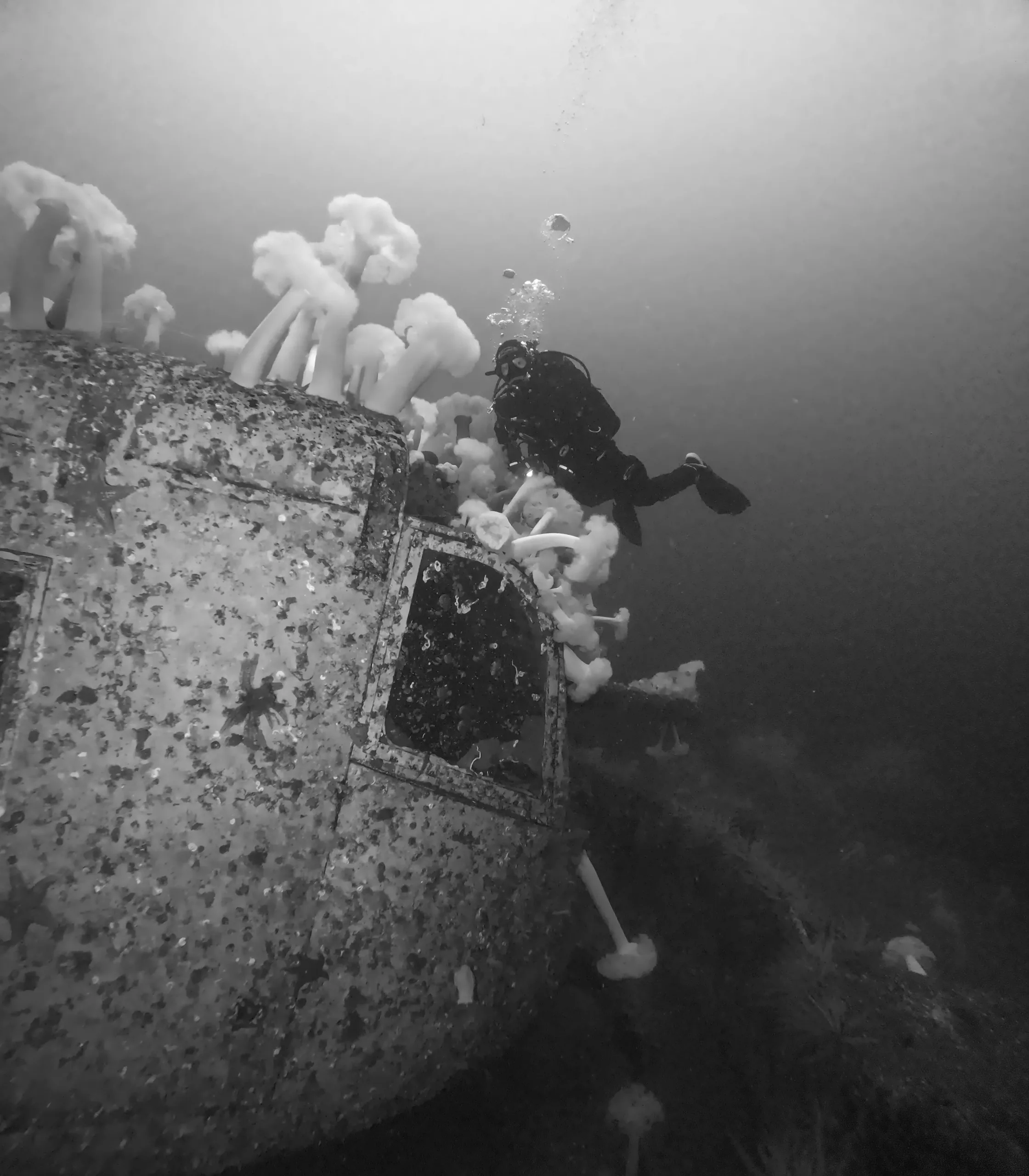
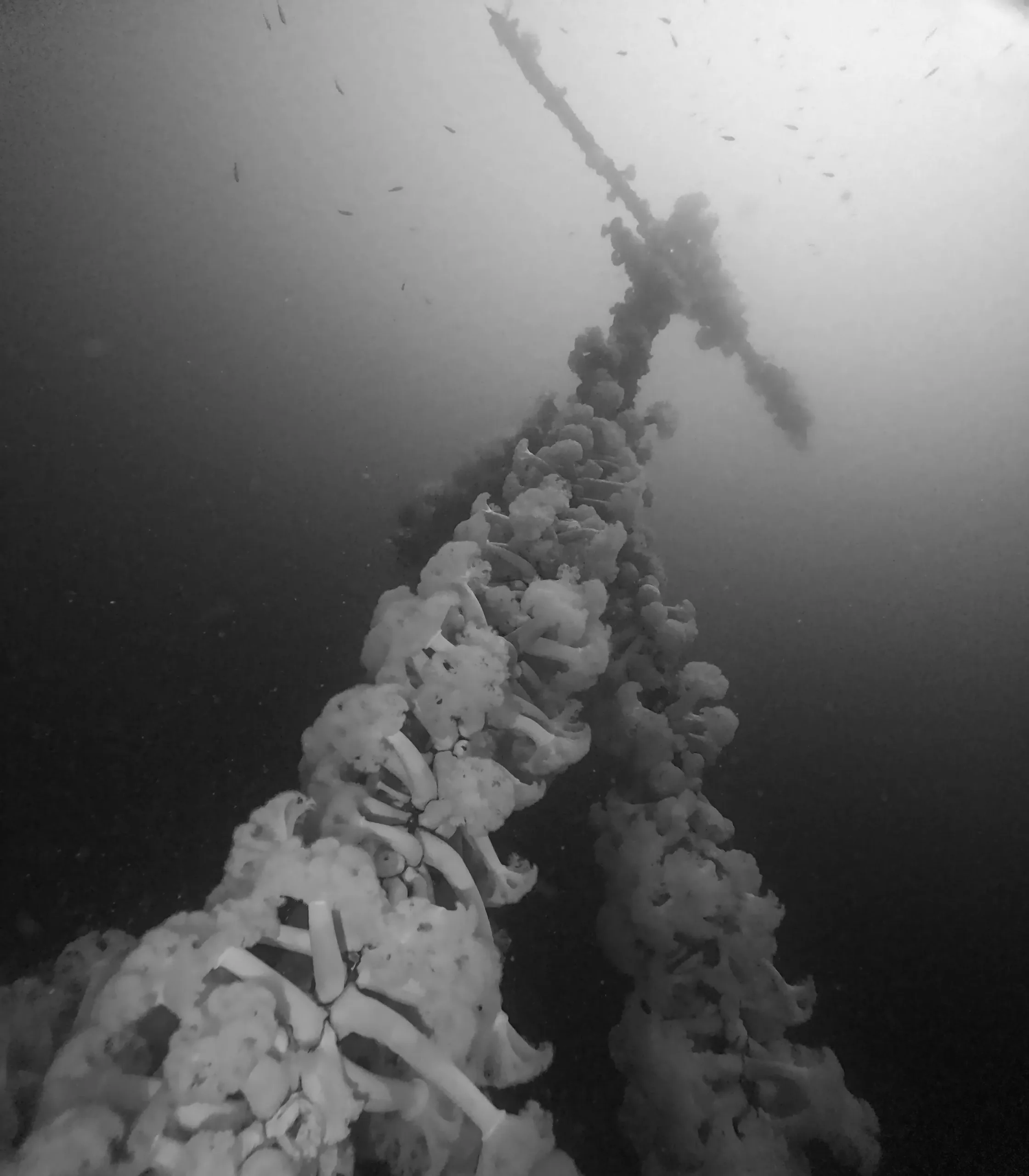
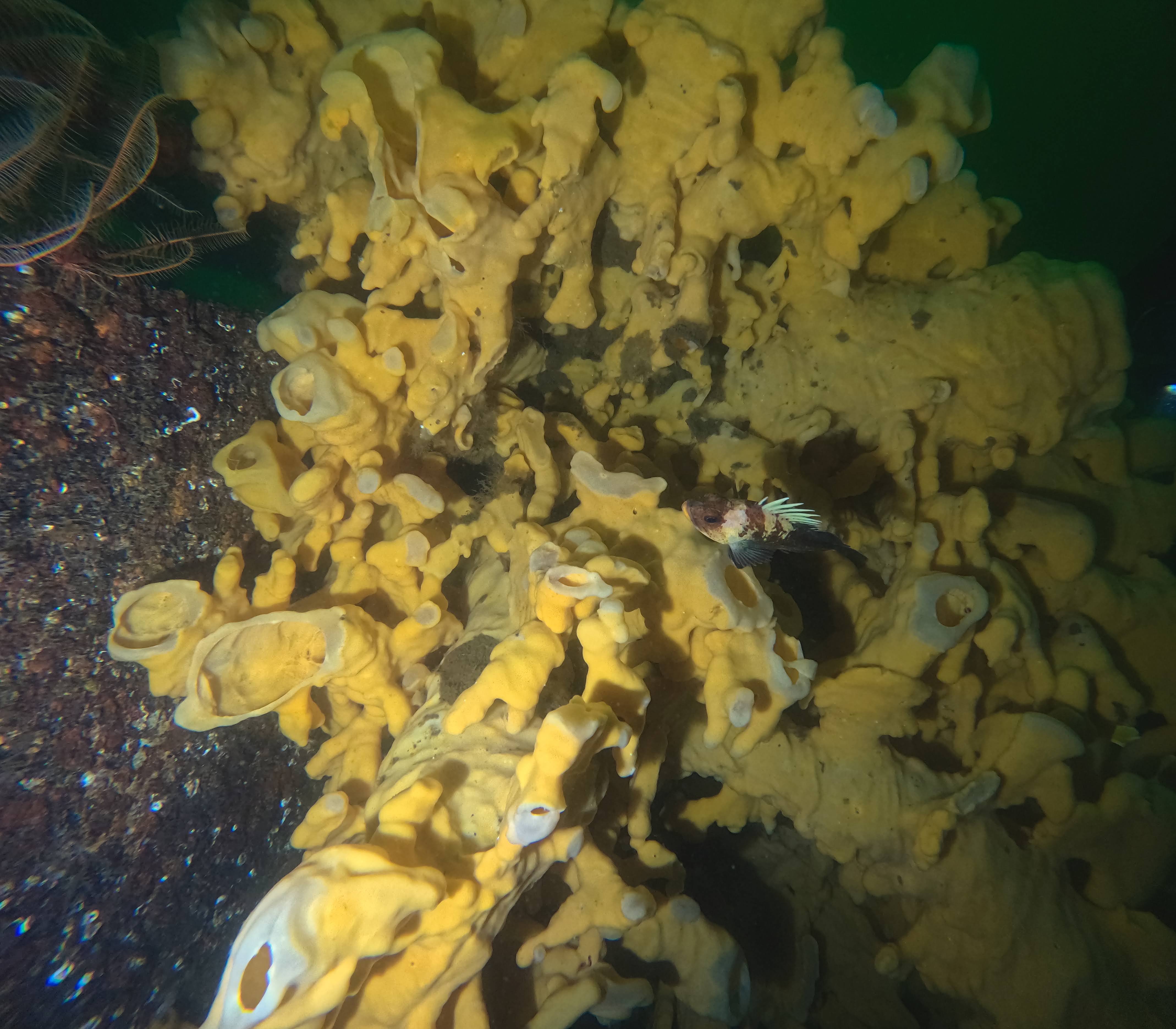
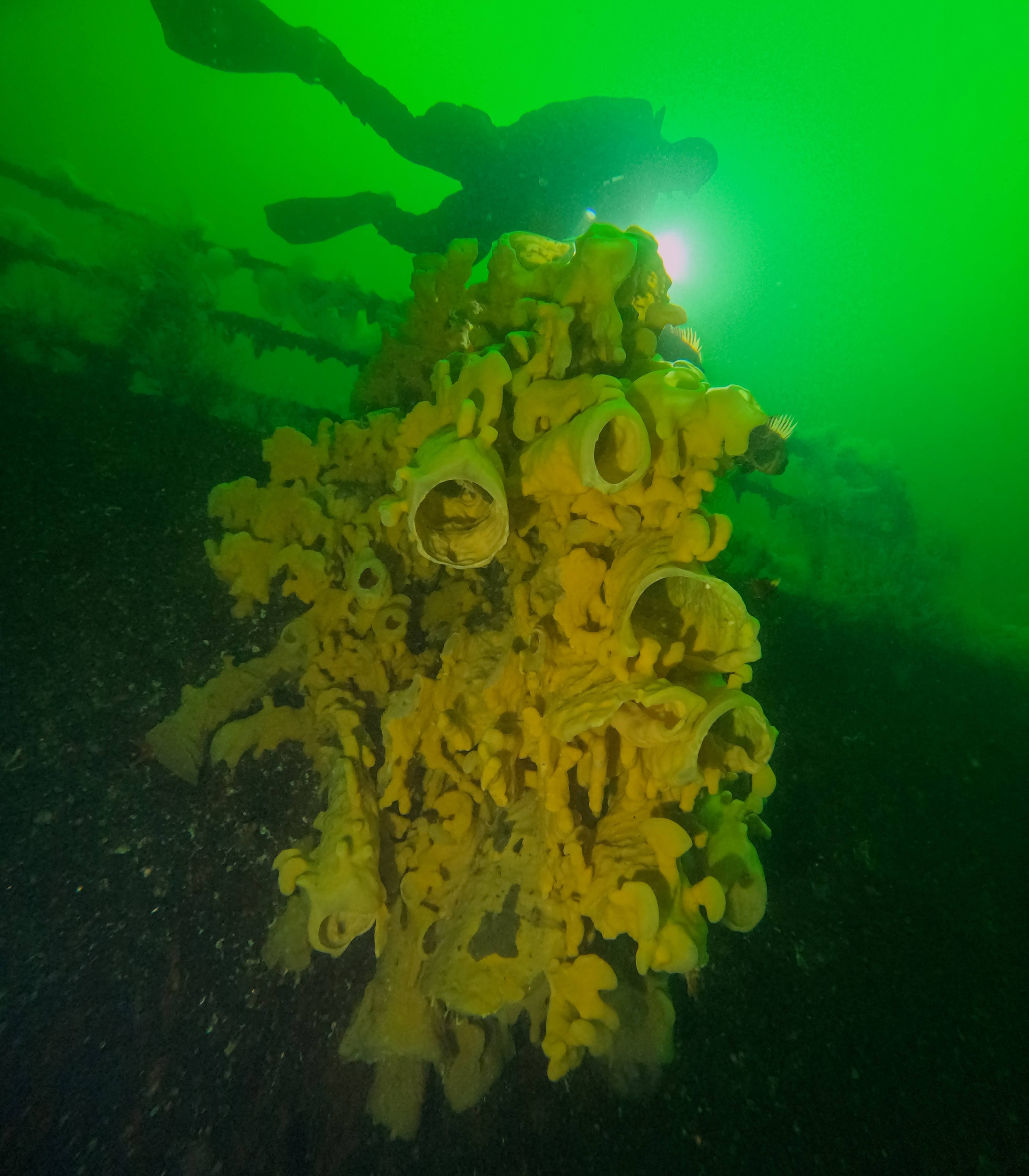
- What We Saw: Plumose anemones, large cloud sponges, China rockfish
>> Read more: Artificial Reef Society of BC — HMCS Cape Breton
Dive day 2: HMCS Saskatchewan
- Depth: Deck ~80 ft, bottom near 140 ft
- Sunk: June 1997, intentionally, by the Artificial Reef Society of British Columbia
- Size: Upright, 366 ft (111 m) long
- Skill Level: At least AOW for depth and cold water; Nitrox strongly preferred
- Visibility: 5–10m, variable
- What We Saw: Plumose anemones, China rockfish, vermilion rockfish, cloud sponges; another group on the boat reported a yelloweye rockfish and a large wolf eel on deck
>>Read more: Artificial Reef Society of BC — HMCS Saskatchewan


Final Thoughts
Wreck diving is a lot of fun. We booked this trip right around the time we put a deposit down on Truk Lagoon in March 2028, and descending into green water with the wreck slowly coming into view, with plumose anemones and cloud sponges everywhere, is a hell of a sight. I was in awe and couldn’t speak for a moment. K was doing his happy dance.
UB Diving is a great tech-friendly operator. Across the two days diving, our group had 3 sidemount divers, 1 CCR, 4 backmount divers, and a couple of DPV/scooters (one team scootered the line between Saskatchewan and Cape Breton). Operational logistics were seamless despite the mixed configs.
Sean, the captain, is funny and knowledgeable about all things diving and oceans. On day 2, a diver lost his GoPro lens during the first dive. Sean donned his own gear during the surface interval and went to look for it, and was back with the lens in fifteen minutes, plus a bonus find: a torch that barnacles had already moved into. The shop’s other employee happened to be out with us that day too, so the boat wasn’t left unsupervised while Sean was in the water.
Sean told us 2026 was their first year testing waters for Nanaimo wrecks, and I’m glad we jumped on it early. Already planning to come back with tech gear to explore more. And that elevator means no back-breaking stair climbs in a drysuit. A BIG plus!
>>Read more: what a smaller-scale PNW day boat trip looks like on “PNW Dive Report: Zipping to Fox Island with Bandito Charters” in Puget Sound
>>Read more: My very first boat diving experience in PNW “PNW Dive Report: Saltwater Therapy with YSS and “Miss Gig”” in Hood Canal
>>Up Next: Trip report once Truk Lagoon happens — the deposit’s already down, and hopefully the wreck blooming with marine life will practically write itself.
Frequently Asked Questions
Are Nanimo wrecks good for beginners?
You’ll want at least Advanced Open Water and cold-water experience — the wrecks sit in the 60–140 ft range with variable visibility. Nitrox is strongly recommended. Recreational divers are typically limited to the top deck due to depth and no-decompression limits.
What’s included in the price?
Two AL80 tanks and air are included in the base price. Nitrox is available for an additional fee per tank.
Where do UB Diving’s Nanaimo charters depart from?
As of 2026 June, Brechin Boat Launch in Nanaimo, BC. Parking is CAD $6/day.
Where does UB Diving run day charters the rest of the year?
June/July — Nanaimo wrecks. April/May and Sept/Oct — God’s Pocket.

About Pan — Full Cave and Advanced Recreational Trimix diver based in the Pacific Northwest. I started diving without knowing how to swim; now I drive three hours each way to dive in Puget Sound/Hood Canal. Two Ocean Notes documents the technical progression, gear decisions, and travel planning behind this dive life — from a petite engineer’s perspective, without the fluff. → Read my full story
FOLLOW ME
For My Latest Dive Stories & Journey
Tags:
Editorial disclaimer
Please be aware that scuba diving is an inherently risky activity, even with certification and experience. The content on this blog reflects my personal opinions and experiences and should not be considered instructional. Always prioritize safety, seek guidance and certification from qualified diving professionals, and carefully consider the risks involved in any dives.
Discover more from Two Ocean Notes
Subscribe to get the latest posts sent to your email.

